Sunday, July 02, 2006

Russia: Foreign Wines Dry Up

After July 1, the imposition of a new law on liquor combined with usual bureaucratic tardiness threaten to dry up the Russian wine market by making imports of foreign wine virtually impossible for several months.

The new law aims at blocking the wide spread of counterfeit liquor by requiring mandatory excise labels on all wine and liquor bottles sold in the country. Despite the fact that the law has been long expected, Russian authorities have been slow in taking practical measures for it to work. Earlier this year, Russian liquor consumers were hit by a similar bureaucratic foulup, when there was a sudden lack of equivalent labels. Someone had simply forgot to order the labels in time for producers to put them on their bottles, which created a short but shaking "vodka crisis" for Russian society. Whether the issue was solved by postponing implementation of the law until now or if it is a case of separate laws with similar content is unknown. Nevertheless, the result is once again more or less the same.

This year, Russian liquor vendors have been especially hard hit by misdirected or poorly implemented government measures. In April Russia imposed an embargo on imports of the vastely popular Georgian and Moldovan wines, tendering a more traditional and low-price market. This might have been an eye-opener for consumers, but after some confusion Georgian wines were substituted with wines from other countries. This option now seems to peter out.

Indeed, representatives of liquor retailers do not expect that the market on imported alcohol will work properly again until November. Retailers expect a loss of some 900 million USD in revenues and that up to a third of Russian liquor stores might close indefinitely. Why the government has so blatantly bungled the issue remains unclear. Favouring a next to inexistant domestic wine production can hardly serve as an explanation, if the foulup is not directed at supporting Russia's vodka producers. The latter would, however, make no sense while such a move would but incur higher state costs for the consequences of alcholism. So, in lieu of any better explanation, one may only assume that this is yet another blunder of the infamous Russian bureaucracy.

Thursday, June 29, 2006

Kazakh Leader's son-in-law New Oil Mogul

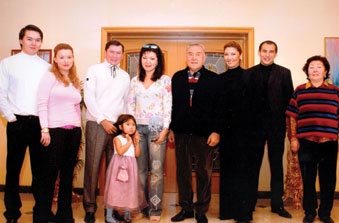
On Tuesday, Timur Kulibayev, Kazakh leader Nazarbayev's son-in-law, was elected chairman of the country's state oil and gas company, Kazmunaigas, Reuters reports. This strengthens the tendency towards increasing control of key positions in Kazakh society by the Nazarbayev family.

As is already the case, the Nazarbayev family exercises a disproportionate influence over Kazakhstan. Only last week, news came that Kulibayev's wife and presidential daughter, Dinara, is a large indirect owner of Halyk Bank, the country's third largest bank. Another daughter, Dariga, is a party leader and an MP, whereas her husband, Rakhat Aliyev, serves as deputy foreign minister.

The 65-year-old Nazarbayev is Kazakhstan's leader since 1989. During his reign, he has often been accused of nepotism and it is quite obvious that he deliberately places family members on central posts in government and business to gradually exert greater control over Kazakhstan.

Wednesday, June 28, 2006

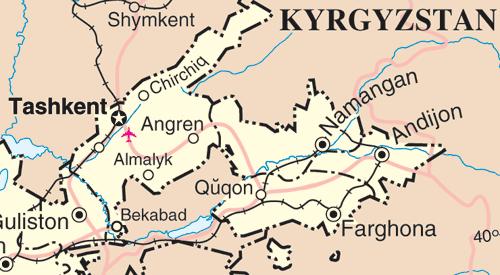
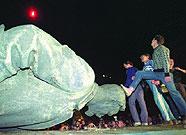
Uzbekistan: Video of the Andijon Uprising

Last week, New York Times reported about video recordings from the events leading up to the 2005 Andijon massacre. The tapes were confiscated by Uzbek authorities after the massacre and have been used as evidence and propaganda by the Karimov regime. However, they may be interpreted in various ways, and cast considerable doubts on the Uzbek version of events. This comes as no surprise as the official Uzbek story has been twarted from the very outset. However, the tapes also give a much more complex picture of developments in Andijon prior to the massacre than has previously been the case.

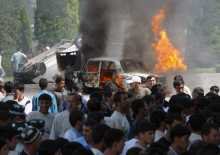
In May 2005, public protests against a number of arrests in Uzbek city of Andijon led to a massive jail-brake. Protests were sparked by a trial of 23 local businessmen charged with involvement in Islamic extremism. On 12 May, an armed crowd stormed the local prison and prisoners were released, including also heavy criminals. By then, public disconent had peaked and people flooded the streets in massive demonstrations against the Karimov regime, which were to be know as the Andijon uprising. On 13-14 May, demonstrations were brutally quashed, and as many as 750 people - mainly civilians - were killed, although Uzbek officials have put the death toll at a mere 169. Thus far, accounts more or less concur.

The Uzbek government's version of events was that an uprising of Islamist extremists - with links to al-Qaida - had been put down by police and interior ministry troops. This version, backed also by Russia and China, holds that there were next to no civilian casualties and that the action was directed against Islamist insurrectors and bandits. Of course, this story is evidently incorrect. Testimonies by Andijon refugees instead clearly point to a majority of civilian casualties. Furthermore, it seems that also the military was used against civilians, at least judging from what arms apparently were used to put down the rebellion.

As the story came across to the international audience, more or less peaceful demonstrators had been brutally massacred by the Karimov regime. This version must be seen against the background of discontent over social and economic conditions that swept over Uzbekistan in Spring 2005.

As a consequence, massive international protests against the massacre were levelled against the Karimov regime. Thus, the international community reacted to the Andijon events. Following the lead of the UN High Commissioner for Human Rights, the OSCE called for an independent international investigation to find out what transpired in Andijon during those fatal 2005 Spring days. In September 2005, the EU imposed sanctions against the Uzbek leadership, walking a thin line between Human Rights concerns and the needs among its member states for the continued use of the Uzbek Termez airbase for supplies to international operations in Afghanistan. Still, such considerations were eventually put aside, and in retaliation Uzbekistan banned Nato, the US and most EU-states from continued use of Termez.

As is often the case with sanctions, international measures against the Uzbek leadership were somewhat blunt, hitting also reform-oriented regime politicians, e.g. the Uzbek Minister of Defence, Kadyr Gulyamov. Western critics of the sanctions have also argued that the only result was to drive Uzbekistan into the arms of Russia, while at the same time losing all possibilities for Western influence over political developments in the country.

Until now, the real events that took place in Andijon have remained obscure. The 70 minute recording now obtained by the New York Times gives a more nuanced picture of events leading up to the massacre. Recordings show the demonstrations after the prison-break but before troops arrived to quash the rebellion. Most of the demonstrators are unarmed civilians, but a number of armed insurgents and criminals take cover in the crowd. Also, a convicted murderer as well as a known female drug-dealer are agitating to the crowd to stir up wider protests. It is simply obvious that some of the escaped prisoners try to exploit the situation to their own advantage. However, it is even more obvious that the overwhelming majority of demonstrators are unarmed civilians exercising their democratic rights. Also, young men making Molotov cocktails are portrayed. When fire fighters arrive to put out fires ignited by insurgents, they are not only hindered to do so, but also taken hostage.

That public protests of this kind should warrant action by the police or interior ministry troops is clear. Needless to state, Uzbekistan - as any other state - has the right to preserve public order by the legal means at hand. However, there is no excuse for massacring civilians in the process of returning order. It is all too evident that the Karimov regime knowingly used excessive force to set an example to the Uzbek people to put an end to protests that had been growing throughout Uzbekistan during Spring 2005. That armed insurgents and criminals used civilians as cover and exploited public discontent in Andijon can never motivate indiscriminate shooting at civilians. Uzbekistan committed a haineous act against its own people no matter what the rationale for it might have been. That the now published recordings gives a more nuanced picture of events does not change this in the least, but only adds to what many observers guessed already from the outset, given the factors involved. Andijon still stands out as Karimov's worst crime. Let us but hope that the world and the Uzbek people will escape a repetion of similar events elsewhere, despite continued repression.

Tuesday, June 27, 2006

Russia: Putin's Power Purge?

In recent weeks, rumours have been going around that Putin is about to clamp down on Russia's legal and security structures. The reason for this, would allegedly be that they have grown too powerful and independent for the Kremlin. A purge among its ranks would consequently serve to set the balance right between security and economic interests. However, at a closer look, these rumours seem more an effect of simplification than a correct assessment of the realities of Russia's complex political landscape.

The reason why rumours were in sway, is a number of recent dismissals of high-ranking officials. The structure mostly affected seems to have been the customs services. Thus, Aleksandr Zherikov, head of the federal customs committee was dismissed in May, to be replaced by Andrei Belyanikov. At the same time, the Federal Customs Service was transferred from the ministry of economic development to direct government supervision. Also, Interfax reported that Vladimir Shamakhov, first deputy head of the Customs Service, might tender his resignation. Furthermore, two first deputy heads of the service were retired, namely Yuri Azarov and Leonid Lozbenko.

Turning to the Interior Ministry, a number of high-ranking ministry officials have been sacked from their posts. Also, the Federal Security Service (FSB) has been hit. Thus, three generals have been retired - Kolesnikov, Plotnikov, and Fomenko. As for the judiciary, some prominent judges and prosecutors were dismissed at the same time. Then, the Chairman of the Federation Council announced that a number of Senators were about to be relieved of their powers.

As all these actions occurred more or less simultaneously, there is no wonder that anticipations of a coming Putinist power purge were raised. When Putin announced the dismissal of his old ally Vladimir Ustinov, who recently got his term as Prosecutor General prolonged by five years, many drew the conclusion that the president was about to clamp down on the power structures. However, it did not take long before the soufflé collapsed. Only days later, Vladimir Ustinov was appointed Minister of Justice.

So, what conclusions might be drawn from this? First, that so much creedence has been given these rumours testifies to the tendency of Western analysts to overestimate political tendencies and occurrences in today's Russia. The system of power has become so closed that people are increasingly resorting to guesses. Secondly, the measures per se should not be underestimated. It might well be that Putin is preparing to reform the power structures, but then on a much narrower scale than these rumours have indicated. Third, some caution should be made when analysing Russia from a system's point of view, especially when relating changes in various structures to each other. The risk is that you wind up with wrong or exaggerated conclusions. Finally, what at a time seemed as a Putinist power purge, in reality turned out a mere whimper.

Thursday, June 22, 2006

Ukraine: New Government in the Making

On Wednesday, news broke that a new orange coalition government is forming in Ukraine. Both president Yushchenko's Our Ukraine and the Timoshenko bloc (BYuT) confirmed that an agreement had been reached. The news comes amid rumours that Yushchenko was teaming up with orange revolution enemy Yanukovich and his Party of Regions.

If the deal goes through, Yulia Timoshenko will once more become Prime Minister, which has been her primary goal since she was sacked from the post last September. The coalition will be between Our Ukraine, BYuT, and the Socialist Party, which has been the main negotiating approach all along.

Indeed, negotiations to form a coalition between Our Ukraine, BYuT, and the Socialist Party, have been underway ever since the 26 March parliamentary elections. At the beginning of April, Our Ukraine announced that unity had been reached. Then, nothing happened. In mid-May, it was Timoshenko's turn to declare that a new government had been agreed on. Once again, nothing happened. So, one might well perceive news from Kiev on a new cabinet with sound skepticism, were it not for a constitutional deadline on forming a government. Therefore, it now appears that Ukraine will eventually get out of its post-election political deadlock. However, as BBC's Kiev correspondent states, "The deal will not be certain until it is signed."

If the deal goes through, BYuT is said to receive a dominant 11 cabinet posts, including the Premiership. Our Ukraine will get the post as speaker of the Parliament, and has already nominated Petro Poroshenko. The Socialist Party will appoint the vice-Premier.

By all appearances, Ukraine will be in for a tough political ride with its new cabinet. Neither president Yushchenko nor Poroshenko stand Timoshenko, since the fall-out and scandals leading to Timoshenko's dismissal as Premier last September.

Moreover, constitutional changes this year weaken the presidential powers to the benefit of parliament - the Verkhovna Rada. The Rada has a long tradition of relative independence, playing its role in the political balance of power, and party allegiance is far from granted. With fiery and controversial Yulia Timoshenko as Premier, parliament may decide to get in the way of her plans at leisure.

However, there is one strong binding-force uniting the new government. The political forces of the Orange Revolution has failed once. This time they have to succeed or face total political discredit for the foreseeable future. Thus, as Ukrainian political analyst, Volodymyr Fesenko, put it to AFP: "It's a second chance and if they fail, they'll all go down together."

Turning to Ukraine's international relations, with Timoshenko as Prime Minister, relations with Russia are in obvious jeopardy. Already the same day that the new coalition was announced, Timoshenko called for a review of the Russian-Ukrainian gas deal that ended the New Year's gas crisis earlier this year, BBC reports.

In addition to this, the US Marine Corps participated in exercises on the Crimean peninsula a few weeks ago, which sparked fears in Moscow of Ukrainian ambitions to join Nato. Thus, Russian foreign minister Sergei Lavrov warned Ukraine that such a move would seriously hurt relations Moscow and Kiev.

The majority of Crimeans are ehtnic Russians, and the Black Sea peninsula was transferred from Russia to Ukraine as late as in 1954 by Soviet leader Nikita Khrushchev. Therefore, the presence of US troops in a disputed Ukrainian region does not serve to improve Ukrainian relations with Russia. Indeed, the government that is now being formed will inevitably have to meet major challenges in its relations with the Kremlin.