Thursday, March 30, 2006

Ukrainian Election Results

According to Russian news agency Interfax, the results in Sunday's parliamentary elections in Ukraine are now next to ready with 99.4% of votes counted by the Central Election Commission. Thus, only five parties out of 46 have passed the 3% parliamentary threshold, leaving 22,32% of the voters without parliamnentary representation. The results are as follow:
Major parties not represented in parliament are: Natalya Vitrenko Bloc (2.91%), Popular Bloc - Lytvyn (2.43%), Kostenko-Plyushch Popular Bloc (1.88%), Viche party (1.74%), and the Pora-PRP bloc (1.47%).

The division of the 450 parliamentary seats would be as follows:
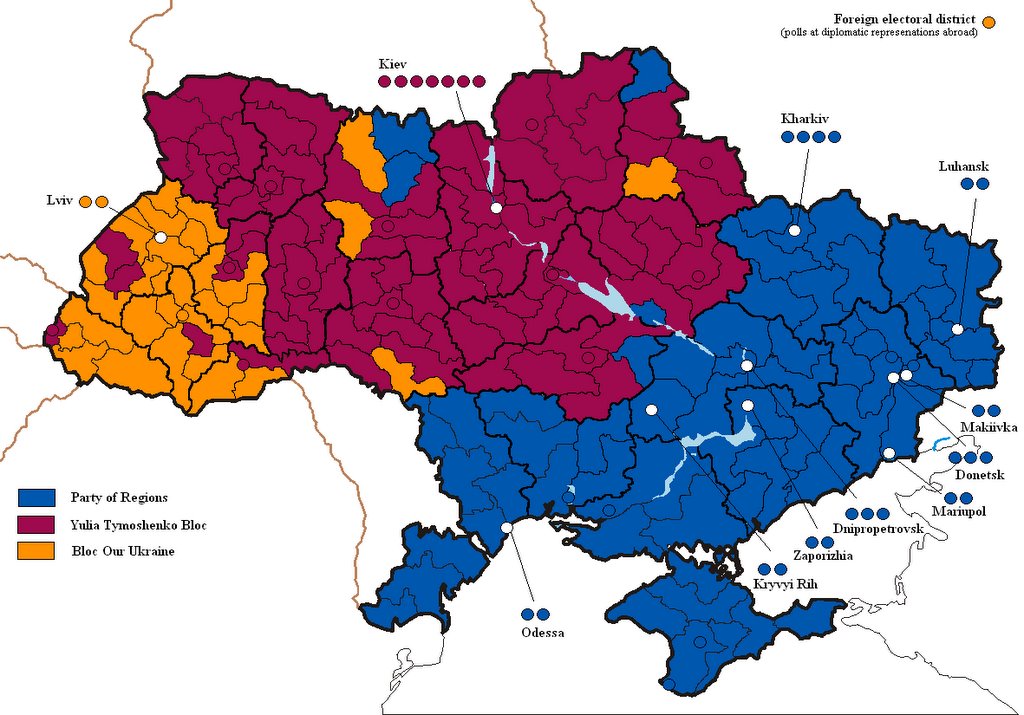
As for regional division of votes, the pattern is as expected (cf. map). Thus, Yanukovich's Party of Regions won in Eastern Ukraine (blue), the Yulia Timoshenko Bloc in Central Ukraine (red) , and Yushchenko's Our Ukraine (orange) in the West.

Yanukovich Party of Regions won in the following regions of mainly Eastern Ukraine:
  • Donetsk
  • Luhansk
  • Zaporizhzhya
  • Kharkiv
  • Mykolayiv
  • Odesa
  • Dnipropetrovsk
  • Kherson
  • Sevastopol
  • Crimea
The Yulia Timoshenko Bloc won 14 regions mainly in central Ukraine:
  • Kyiv
  • City of Kyiv
  • Volyn
  • Cherkasy
  • Khmelnytsky
  • Ternopil
  • Chernihiv
  • Vinnytsya
  • Sumy
  • Rivne
  • Chernivtsi
  • Kirovohrad
  • Poltava
  • Zhytomyr regions andin the
Yushchenko's Our Ukraine won mainly in the western regions:

  • Ivano-Frankivsk
  • Lviv
  • Trans-Carpathian

The tendencies previously accounted for here, thus seem to strengthen and government negotiations will prove interesting. However, we will see how long Yanukovich - Ukraine's comeback kid - will have reason to cheer. Most severe, however, is the big voter fallout due to the 3% parliamentary threshold. With 22,32% of the voters without parliamentary representation, Ukraine faces an enormous democratic deficit threatening the legitimacy and stability of the political system. This, the OSCE and the international community cannot compensate, no matter how much Ukraine is praised and commended for free and fair elections. After all, losing a fifth of the plebiscite must be taken seriously, for nobody knows where they will turn next time.
Wednesday, March 29, 2006

Lukashenka's Disappearing Act?

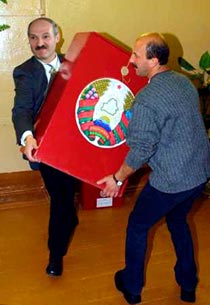
This Sunday, Belarus dictator Alyaksandr Lukashenka was reelected with some 82% of the votes. However, since 20 March Lukashenka has not been seen in public, and people are starting to wonder where the triumphant victor is. Now, news from Minsk has it that the presidential inauguration, set for Friday, has been postponed until sometime in April. According to official sources, the president is busy dealing with administrative issues. The question remains: Where is Lukashenka?

The absence of a leader at a critical point and feeble excuses for this, would, during soviet times, have given way to speculations whether a palace coup was in the making. Cases such as Khrushev, Gorbachev and others are but examples of methods to depose an inconvenient leader. Rumours, unclarities and the regime's nervousness lately, makes one wonder whether something really is in the making. The appearance of and leeway given to the new opposition leader Kozulin only add to speculations. Is Lukashenka - for some reason unseen by us - losing his grip on power? Well, one cannot help wondering, even if it may only be the hope of the weak in confrontation with oppressive power. Still, the explanation for Lukashenka's absence may be very simple: He is too busy counting all the votes he "got".

Tuesday, March 28, 2006

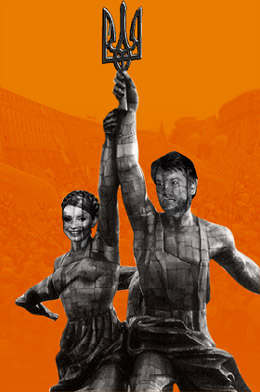
Yulia Timoshenko Election Posters

Ukrainians, by now, must be quite fed up with all election posters, but it is simply too hard to resist posting some of Yulia Timoshenko's posters here. One may wonder whether this youthful image is part of her success with the electorate on Sunday.

An obvious first choice is the new party symbol of Yulia Timoshenko's bloc - a graffiti heart.

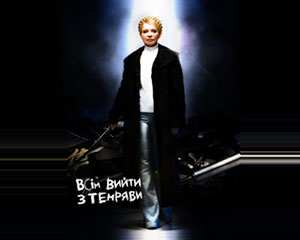
Next, we have the culprit herself - caught red-handed (painted?) with corpus delicti just behind her. My Ukrainian, regretfully, is not good enough to decipher what it says, but I would guess that it is something like "they cannot put you down anymore". And what is the no. 36? I seem to have missed something. Any suggestions from someone who knows? Could it be her number on the ballot? With 45 parties running for parliament, this might be a logical explanation, but who knows? It also appears somewhat impractical to go out for a graffiti-ride dressed all in white, but probably Timoshenko has little experience of this.

Then we have the classic: "Fast forward Ukraine!" with Yulia - who else? - riding her country towards the future ["Only forward" - to be correct]. She must be a nightmare to her hairdresser. As some of you probably know already, her rye-blond hair is a rather recent invention. Just a couple of years back, her hair was raven-black. -Variatio delectat. There are stories of how she visited New York in the 1990's, all dressed up in mink-coat and with jewellery the quantity of the medals of a marshal of the Soviet Union. Needless to say, this did not go down all that well with the ladies on Fifth Avenue. So, Timoshenko's new look is still much to prefer, and at least it makes her hairdresser - visiting her each morning - a rather wealthy woman.

Finally, we are back with the youthful and innocent Yulia, classically dressed in angel-white and with a becoming pearl-necklace braidered round her pompous neck. A true heroïne proclaiming "I am with you!". One wonders whether this is a genuine creation or something made up by the fashion houses of Paris 8th arrondissement. That people may admire Timoshenko as a very talented politician is one thing, but who is she kidding with her combined image of "girl-power" and innocence? Or is this it - what the voters want? Anyway, it is of minor consequence here. What matters is that these hilarious posters will be kept as a reminder of the choice of a new generation in Ukraine.

Ukraine from Orange to Blue?

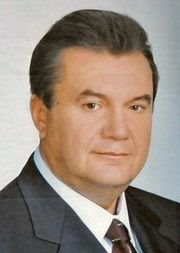
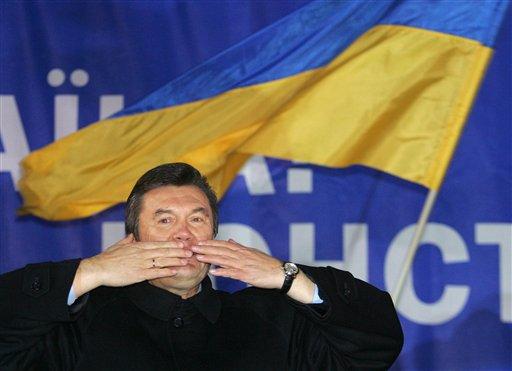
Will Sunday 26 March 2006 go down in Ukrainian history as the end of the Orange Revolution? This is undeniably the impression one may get when half the votes of Sunday's parliamentary elections have been counted. Last year the Ukrainian people ousted Viktor Yanukovich for fraud in the presidential elections. Now, he stands as victor in the first parliamentary elections since the orange revolution. Is this - in line with Yanukovich's party colour - the blue counter-revolution?

With some 27% of cast votes, Yanukovich's Party of Regions is currently in the lead ahead of Yulia Timoshenko's 23% and Yushchenko's Our Ukraine's 16%. That Yanukovich would win the elections comes as no surprise, with polls giving him some 30% support over the past months. What came as more of a surprise is that president Yushchenko stands out as the big loser in the elections at the same time as Timoshenko has strengthened her support by almost 10% more than was expected only a few weeks ago.

What now? Judging from the results, it is still no done deal which parties will form the new government. As of now, two other parties - the Communists and the Socialists - have crossed the 3% threshold to parliament. It thus seems as if we are in for a lot of negotiations over the next week to form some sort of a coalition government, and what options are possible will be clear only when we know how big each party's parliamentary representation will be.

What is by now quite clear, is that president Yushchenko may have great difficulty to exercise his power during the remainder of his time in office. The results are not only a humiliating blow to Yushchenko, who thereby is made a scapegoat of failed policies over the past year. Due to changes in the constitution, presidential power has also been reduced and now Yushchenko may lack parliamentary support to back his policies, potentially making him into a lame duck. The question is if he will accept the roles of both scapegoat and lame duck?

In an attempt to seize the initiatve, Yulia Timoshenko called for talks with president Yushchenko to form a new orange coalition between her party, Our Ukraine and the Socialist Party, headed by Moroz. The question is whether Yushchenko has much alternative to accepting this proposal, even if it might make him a puppet on a chain in the hands of Timoshenko. In September last year, former orange allies Yushchenko and Timoshenko had what seemed as a final fallout and Timoshenko was sacked from the post of prime minister. If an orange coalition is to rule Ukraine after the elections, Timoshenko's comeback to power is assured. The question is also whether the Socialists may be able to again join forces with their former orange allies in conforming to the government policies of Yushchenko and Timoshenko. This has proved complicated in the past.

The alternative to the Socialists would then be to join forces with Yanukovich's Party of Regions and Symonenko's Communist Party to govern Ukraine in an anti-Yushchenko coalition. Such a coalition would improve relations with Russia at the same time as Yanukovych might have greater diffuculty to develop relations with the European Union than he would really want to. Such a blue coalition might also be better in tune with popular sentiments than the orange alternative, which may prove a factor in coalition negotiations. A third option of forming a Yanukovich-led grand coalition with Our Ukraine and the Socialists must now be ruled out as it would include the loser - Our Ukraine - and exclude a winner - the Timoshenko bloc. This is not the message the voters sent and - in contrast to 2004 - Ukrainian politicians have learnt to listen a little more to the people.

What government alternative eventually evolves is still unclear, but Ukrainian politics certainly have taken a peculiar twist, which only will make it the more interesting in the coming years. What, to the contrary, is already clear is that Yushchenko no longer can rest on his laurels as the hero of the Orange revolution - regardless of whether he will turn out a scapegoat, a lame duck or a puppet on a chain. The big question, however, is what it would mean if Ukraine now turns from orange to blue with a comeback of Viktor Yanukovich as Prime Minister. Hopefully - if not altogether realistically - this day will never come. As for the future of the orange revolution, the people and not the politicians will be the better judges on that, and this was an election - not a revolution.

Saturday, March 25, 2006

Belarus: Demonstrations Split Opposition?

Reports from Minsk are currently pouring in by the hour. What is most interesting is perhaps that there seems to be an increasing rift between presidential candidates Milinkevich and Kozulin.

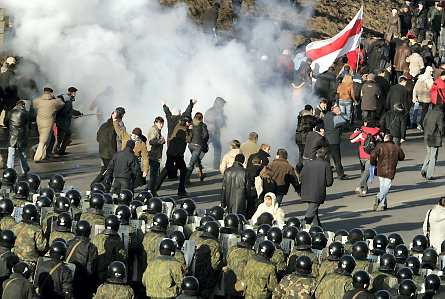
In the early morning yesterday, the sit-in demonstration on Oktyabrskaya Square in Minsk was disbanded by riot-police. The sit-in appears, by that time, mainly to have consisted of youth from the Zubr movement. The bulk of the opposition movement had by then already given up on the sit-in and wanted to make a new go at demonstrations today, Saturday. As thousands of demonstrators today poured into the streets of Minsk, riot police still succeeded in barring them from getting to Oktyabrskaya Square once more. Instead, people gathered in the nearby Yanka Kupala park, dedicated to a Belarusian national hero. Speaking to the masses, opposition leaders Milinkevich and Kozulin adopted a resolution calling for new elections - without participation of Lukashenka.

What then transpired is still not wholly clear. Kozulin called for the demonstrators to move towards the Okrestina prison to free their co-demonstrators interned there, despite the fact that Milinkevich resisted such action. Many demonstrators, however, started moving towards Okrestina, and on the way there, Kozulin apparently was arrested by police.

The main opposition leader, Milinkevich, afterwards reportedly said: "What Kozulin did was a provocation." The effect of Kozulin's action was that demonstrators split in two halves - thus more easily dispersable by the police - and that Kozulin got even more attention than before due to his arrest.

This adds to the impression that Kozulin has alterior motives for his poisture as an opposition leader. That he is a populist is by now quite clear. That his actions repeatedly serve the interests of the Lukashenka regime, by splitting the opposition, is by now becoming even clearer. One must, therefore, ask to what extent Kozulin serves his own or Lukashenka's interests. The question is whether the opposition movement is now facing a split between Milinkevich and Kozulin proponents, thus playing into the hands of the regime. Will Milinkevich's plea for unity in the opposition thus go unheard?