 Great fortunes are made by catering to the basic needs of people. This is a fundamental economic fact. What all people need is what all people buy. This is why potatoes during famines have been more expensive than meat. People buy first what they think is most needed, even if better alternatives are cheaper. Alternatively, if there is a choice, subjective factors such as taste and image play an important role in consumer behaviour. The company that succeeds in combining needs and tastes truly sits on a money making machine.
Fast food is perhaps not the first thing that comes to mind when thinking of basic needs, but today the industry generates massive profit worldwide, because an increasing number of people find the relative price in time of fast food lower than that of home-cooking. The niche of fast food manufacturers has broadened to such an extent in many industrialised countries, that the industry is on the verge of catering to the basic needs of people.
One has only to think of the McDonald's saga to realise the enormity of potential revenues if one succeeds in getting a cut of the fast food market. McDonald's success relies on great sensitivity in forming and doctoring a positive trademark for its consumer target group by a common and dynamic concept worldwide. This is McDonald's success story no matter what one may think of how the food chain generates profits. In big-busines, morality has no place when it comes to making money.
So, are McDonald's products significantly superior to those of all other fast food chains as to earn it the market share it has. No, certainly not. What McDonald's offers is simply a well-tuned concept - balancing pricing and trademark - to make customers prefer their products. One always knows what one gets at McDonald's. It is a safe bet. Objectively, though, there are certainly many other better alternatives for consumers. What most alternatives however lack is the concept that continuously draws new generations of customers.
In 1995,
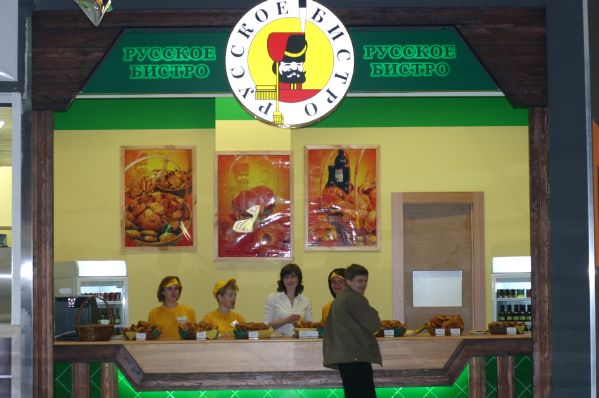
Russkoe Bistro was founded as Russia's first fast food chain. The concept was simple and elegant, namely providing
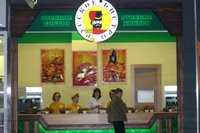
high-quality traditional Russian cuisine in a fast food package at lower prices than its competitors. The products on offer were what customers in Western Europe and the US paid several dollars more for at more up-market restaurants than what they would if having a hamburger at McDonald's.
Russkoe Bistro simply offered better products at lower prices - real food and not the junk offered by most fast food chains.
The menu was meticulously elaborated by the All-Russian Food Institute and little effort was spared to present customers with an appetising assortment of cheap but tasty traditional Russian dishes made entirely out of high-quailty domestic products. The simple and wholesome menu seemed a sure recipe for success.
Furthermore,
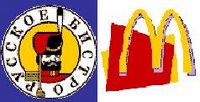
Russkoe Bistro's trademark was carefully chosen to align with an image susceptible to Russian tastes also on the subjective level. The company logotype portrayed a cossack, which in combination with its name -
Russkoe Bistro - conveyed positive historical connotations to consumers.
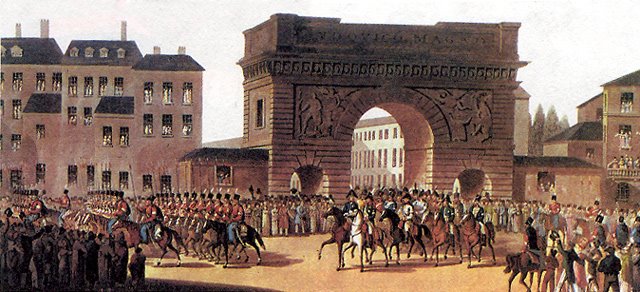
There is a well-known popular story on how the Russian troops that defeated Napoleon in the 19th century, sat about the Paris cafés and restaurants urging the waiters for food by shouting "быстро, быстро!" (fast, fast!). Thus, the world-renowned Paris "bistros" would have originated from Russian troops in Paris celebrating one of their country's greatest historical victories. This was the positive image
Russkoe Bistro exploited. Russia was simply the origin of fast food, so why not reconquer it?
The backside of the logo, some people argued, was however that po
rtraying a cossack in full uniform also brought forth visions of extreme Russian nationalism. Still, having a military as symbol is not unique to
Russkoe Bistro. The well-known logotype of
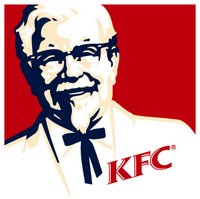
Kentucky Fried Chicken (KFC) portrays an image of its founder - Colonel Harland Sanders. Even if his title was honorific, many Americans still refer to him simply as "the colonel" without thinking the least about the propriety of a military man being the symbol of a fast food chain. It thus seems that the choice of symbol for
Russkoe Bistro was truly ingenious, while most consumers would associate the image with the historical pride of how Russian culture once set a postive landmark far beyond the country's borders.
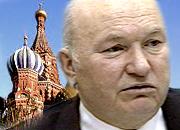
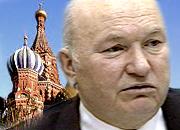
So, did the company owners realise that they were sitting on a potential gold mine? Regretfully not, by all appearance. Originating as a pet project of Moscow mayor Yuri Luzhkov,
Russkoe Bistro had a grand opening intended to score political points for its founder. Its commercially viable trademark was used for political purposes to the degradation of its worth. In a few years, the fast food chain - based on franchising as McDonald's - grew from a mere three to 37 restaurants only in Moscow. This was not least because of massive financial backing from Moscow City. The financial feasibility of the project was a completely different matter as it was run as a quasi-public service.
Instead of generating the big profits that the
Russkoe Bistro concept might have vouched for, little effort was made either to exploit the company's true potential or bring in the revenues that were so close at hand.
Russkoe Bistro was simply mismanaged. This became evident by the August 1998 financial crisis, when the company quickly found itself on the verge of bankruptcy. Trying to respond to crisis, the company management - in contradiction to sound economic judgement - vastly expanded the menu, making it even more difficult for franchisers to break even financially.
The very concept of the fast food industry is to offer an easy-to-make menu with a limited quantity of dishes at low prices for as many customers as possible. The opposite is tantamount to increased costs, higher prices, and much more complex logistics. Expanding the menu is simply a textbook recipe for failure for a fast food company facing crisis. It is no wonder that the turnover of
Russkoe Bistro and its franchisers alike dropped even more drastically than was the case for competing fast food chains.
As the company attracted increasing losses after the 1998 crisis, questions started to amass why Moscow City should keep on funding a defunct enterprise on the verge of collapse. It seemed clear to all, that if Moscow withdrew its support, the company would fall apart within days. Still, the City continued its support in contradiction to financial soundness. Soon,
however, other dark clouds started to gather over the company. Thus, the Interior Ministry started an investigation on the imbestlement of Moscow public funds to the amount of $1,3 million. Apparently, large funds had been transferred via the company in a complex string of financial transactions to foreign bank accounts. The case of
Russkoe Bistro soon became part of the 1999 fraud and money laundering investigation that came to be known as the Chase Manhattan Bank scandal. To this day, many of the financial irregularities surrounding the scandal remains buried by politicians and businessmen that have no interest in the truth being made public. Needless to say, mayor Luzhkov assumed no responsibility for the
Russkoe Bistro part of the scandal and came out of the affaire scots free.
Still, somehow
Russkoe Bistro managed to survive. The company brand had however become strongly tarnished and the fact that it was so heavily associated with public services and handouts, resulted in consumers never feeling that there was something special about the company. Instead of prouding themselves of a food chain that in objective terms was far superior to McDonald's, Muscovites regarded
Russkoe Bistro as an improved version of the traditional Russian
stolovaya - poor quality workplace restaurants. In 2005, the company was sold by public auction at a bargain price. The restaurant chain still exists and is highly recommendable for its good and cheap food. However, the very real chance of creating a contender to McDonald's in Russia was lost, and the value of the company both financially and as a trademark does not vouch for any rapid expansion.
What is perhaps the most tragic element of the
Russkoe Bistro saga is that Russian business for once had a winning concept on their hands, which did not involve the usual easy-to-get profits emanating from natural resources. Russian entrepreneurs stood to gain the great fortunes associated with catering to basic needs. The
Russkoe Bistro concept was not only competitive on the domestic market, but could also have been exported with great succees to Western consumers longing for higher-quality fast food. The paradox is perhaps that a concept so well-tuned to consumer preferences in the West, was not valued highly enough by Russians themselves.
All things that come out of Russia must not be grandiose. Even small things can be great. Regretfully, lack of vision, self-confidence and entrepreneurship remain hallmarks of Russian business to this day. It is true, that the aftermath of the 1998 financial crisis was an eye-opener for the ability of domestic high-quality production of consumption goods. Still, Russia is far from realising that its businesses may be internationally competitive also when it comes to areas beyond exports of natural resources.
With
Russkoe Bistro, Russia had a potential McDonald's on their hands, but lost it due to lack of vision and sound management. If Russia had believed in itself,
Russkoe Bistro might well have reconquered the boulevards of Paris - or for that sake the streets of London, Berlin or New York. Still, just like the cossacks in Paris in 1814 felt ill at ease in a foreign sorrounding, Russian entrepreneurs today may feel that
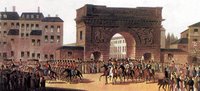
the international market is foreign to them. The question is also if hypothetical current "business cossacks" would bring back unwelcome ideas of reform to Russia as their predecessors once did after the Napoleonic wars. Perhaps Russia will never be ready for the international business battle bringing back ideas for the transformation of economy, society and politics. Or is this what is gradually happening as western-educated Russians now are increasingly returning to do business on their home-turf? Only future can tell.


 Yesterday, a Russian space rocket carrying 18 satellites crashed shortly after takeoff from Baikonur spacebase in Kazakhstan, as reported by international media. The accident presents a serious setback for Belarus new and proud space-programme. The rocket was carrying Belka - Belarus' first to be human-made object in space. As it now appears, this dream was never realised.
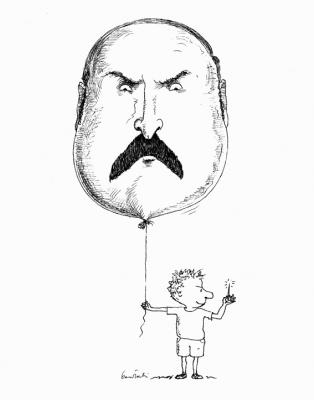 does not master also rocket science, but perhaps not even Lukashenka can be omnipotent. Therefore, someone else has to take the blame for failure. Yesterday, Belarus opposition leader Milinkevich was arrested by police. It will be interesting to see whether he will be charged for sabotaging Belarus glorious space programme. After all, the motto of the regime is: "Together towards a strong and prosperous Belarus!" Then some insignificant little opposition leader should not be allowed to sabotage Belarus' glorious and bright future under the wise leadership of president Lukashenka. Or should he?