However, this is more or less what happened, at least according to Moscow's version of events. Whereas the Russian parliament - the
State Duma - was hesitant to ratify the border treaty, anticipating trouble, Tallinn moved on. Eager to get the question off the agenda before vacations, the Estonian government also put

the treaty before parliament - the
Riigkogu. Reactions to this were negative from the very outset, as many parliamentarians held that the government thereby tried to force through the treaty without proper discussion and debate. To be passed, the bill had to get a 2/3 majority. Such majority suddenly seemed unable to reach, why the government preferred to enter negotiations instead of facing certain defeat. These negotiations resulted in a separate preamble or declaration to the border treaty, referring to the
Tartu Peace Treaty of 1920, by which Soviet Russia recognised Estonia's independence within the pre-WWII borders. However, current borders have been revised during soviet reign, which makes Tartu references unacceptable for Russia. With this preamble, the Estonian parliament passed the ratification.
Moscow's reactionMoscow's reaction was predictable to say the least. On June 21, Russia's Ministry of Foreign Affairs stated that it would not put the treaty before the Duma for ratification. Then, during a visit to Helsinki at the end of June, foreign minister Lavrov declared that Russia had decided to revoke its signature from the border treaty. This is also what happened, and on 1 September president Putin formally withdrew Russia from the treaty. The move to withdraw from an already ratified treaty is next to unprecedented in international relations, and must be considered a very stern reaction. The scandal, a few years back, when president Bush revoked the US signature from the treaty on the International War Crimes Tribunal has reverberated in the international community ever since. Examples are scarce, because the international outcry for doing so is expected too great, and one has to pay too high a price for it to be worthwhile. Still, this was exactly what Moscow chose to do.
Estonian explanationsWhy did the Estonians act in this way, if they clearly understood what the reactions from Moscow were to become? What were they to gain from this? Some suggestions have been made, although they fail to explain for - even in combination - Tallinn's action.
One factor is that Estonia in April 2005 went through a government crisis and that the sacked prime minister and leader of the
Res Publica party, Juhan Parts, quickly needed to profile himself with some cause, not least after a failed unification of Estonia's two right-wing parties - Res Publica and the
Reform Party. Thus, demands connected to the border treaty seemed as a convenient opportunity for Res Publica.
Another reason is that the foreign minister of Ansip's new Reform Party government - 31-year-old Urmas Paet, simply was too new and unexperienced on his post, why he could not manage to deal with Moscow and domestic political intrigues at once.
A third explanation, is that government coalition partners - not least the
Social Democrats with their grey eminence Thomas Hendrik Ilves at a safe distance in Bruxelles - stood to gain from a squabble between the two right-wing parties.
Then, there is Estonian politics' black horse of Edgar Savisaar and his
Centre Party.
Being the new minister of finance, Savisaar was arguably the one pulling the real strings in cabinet affairs. Savisaar is a political survivor with a murky soviet past, who has been constantly scandalised over the years but always gets away without a stain on his popularity, especially among poor and rural population, including the Russians. Also, Estonian conservatives are usually quick to point out that the Centre Party is in union with president Putin's
United Russia, thereby casting suspicion on him for being on Kremlin's leash or even - at times - payroll.
Finally, it must have been hard to put off Russian interests, though not necessarily Russia itself, from the temptation of exploiting Estonia's domestic difficulties in this situation. Whether the Russian factor could hold on to itself in not giving in to such an urge will however remain unclear. The effect was though in Russia's interest. Thus, Estonia stood to gain nothing, but to once again be portrayed by Russia to the great powers of Europe as an amateur in international relations in disrupting the treaty. Still, blaming Moscow is simply too much of going through the motions to be taken seriously. Perhaps, Russia in reality simply had to stand idly by while the Estonians themselves fumbled about in torpedoing the treaty.
So, is there any way out of this mess for Estonia? At an OSCE-meeting earlier this spring, foreign ministers Lavrov and Paet discussed the need for resumed negotiations to settle the border issue once and for all. Some discussions have also been held since, but both parties seem to agree that a ratified treaty will not come into force in the foreseeable future. The issue is simply politically dead at the moment, while so much prestige was put in on both sides to finalise the border settlement. Once this was lost, little room was left for future talks. Estonia thus seems to have little choice but to let the issue at rest for the time being.
Dealing with RussiaIn view of the current situation, how should Estonia handle its relations with Russia? Professor
Andres Kasekamp, director of the
Estonian Foreign Policy Institute, believes that Estonia now will opt for an EU-solution. According to Kasekamp, Estonia should take the CFSP/ESDP more seriously. This is also currently the sentiment among many politicians in Estonia. The country seems intent on playing out the EU-card, despite the Union's demonstrated inability to stand firm on Russia. Such a policy thus seems to have a weak foundation in current realities. That Sweden and Finland were the only other EU-states in support of the Estonian position concerning the border treaty, is a telling example of how little the EU cares about Estonia's relations with Russia. EU politicians are simply fed up with the whole affair of Estonia not being able to conclude a border treaty with Russia for the last 15 years. EU-support thus seems destined to fail, and EU's
European Neighbourhood Policy appears to offer little use to Estonia, as it does not comprise relations with Russia.
The alternative of handling relations with Russia through Nato should, in this perspective, seem all the more tempting to Tallinn. Such a method would, in reality, mean using the US and the Transatlantic link to influence NATO-policy. In May 2005, president Bush
visited Riga, and among other things discussed subjects such as democracy and freedom in Eastern Europe. This kind of US high-level discussions is in the best interest of Estonia, while statements to this fact facilitate setting the Nato-agenda in Tallinn's favour.
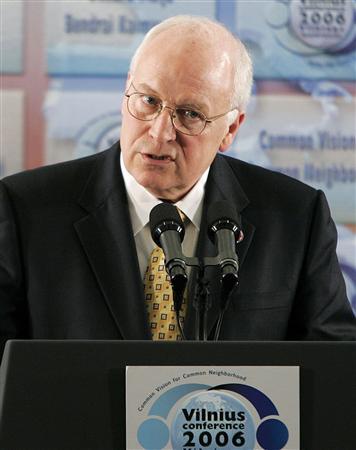
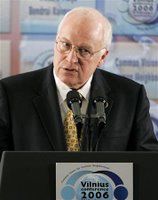
US vice president Cheney's speech at the May
2006 Vilnius Conference also signalled a change towards a more critical stance in US policy towards Russia. In November this year,
Riga will host the annual Nato Summit, offering an opportunity to further Estonian interests in relations to Russia by proxy of Nato. Estonian chances to bandwagon with the US to deal with Russia through Nato are therefore greater than ever. Still, Tallinn strangely enough seems to prefer the EU option - perhaps reflecting the post 2001 change in Nato's geographical focus. What Estonia fails to recognise is the fact that also within Nato, the tide is changing in relations with Russia. Tallinn should clearly not miss out on this opportunity to use a change in US and Nato policy towards Moscow in its own favour.
Finally, a joint approach in coordinating Estonian interests on Russia to concurrently influence both Nato and the EU in the same direction might be a recipe for success, but this is simply too complex a task for a small country to pull off.
Domestic difficultiesIn the meantime, the Russian question in Estonia continues to drag on as an annually recurrent tradition. The drama has been played out by more or less the same actors over the last 15 years with little variation. This year's incident was the 20 May desecration of the Bronze Soldier Monument (Pronkssõdur) by Estonian nationalists. For Russians, it is a memorial to Soviet soldiers who died fighting in World War II. For Estonians, it is a symbol of the Soviet occupation.

Therefore, in connection to Russia's victory day each year, soviet veteran ceremonies at the monument are ritually followed by protests from Estonian nationalists. This year, events have been especially serious with a string of demonstrations. Among Estonian nationalist demonstrators were crackpot professional dissidents such as Holocaust-denier Tiit Madisson, but also more respected people such as former commander-in-chief Aleksander Einseln. Their objective is the removal of the Bronze Soldier from central Tallinn, and little consideration is taken to reasoning in view of their unwavering demands.
The situation has been exploited by extremists on both sides. Last week, the headline of the leading Russian newspaper in Estonia,
Vesti Dnia (fmr.
Sovetskaya Estonia), read: "On the Brink of Civil War." Also, rumours about Russian vandalisation of Estonian monuments, e.g. in Tartu, are spreading, and the resurfacing of old
Interfront activists has been quite unexpected. Probably, protests will peter out in a few weeks, but it is worrisome that extremists repeatedly are allowed to set the political agenda for almost a month each year. This is simply not a sound political tradition for a small country like Estonia. Protests and demonstrations may well be overlooked by the majority of Estonians as an annual freak event, but each year extremists are allowed to set the public agenda through media.
Narva and the Russian-speaking populationWhen one refers to the situation of Russians in Estonia or Latvia, one should be aware of the fact that this does not necessarily mean Russians as such. Migration to Estonia in the post-war era came from all over the Soviet Union, why it might be as natural to come across a Tajik, a Ukrainian or a Lithuanian in Tallinn as it is with a Russian. Today, they all meet the same conditions and requirements for residence permit and citizenship no matter what their place of origin might once have been. That Russians are in a majority should not serve to hide this fact.
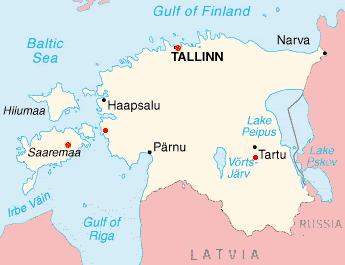
Estonia's Russian-speaking population is concentrated partly to Tallinn and neighbouring cities, and partly to Eastern Estonia. However, it is in the East that the Russian dominance is especially compact - in cities like Narva and Kohtlajärvi. For long, crisis has

coincided with ethnicity in this part of the country, which incidentally also neighbours on the disputed border areas with Russia. Unemployment and social malaise have been a constant feature in Eastern Estonia during the last 15 years. A destitute population with little hope for the future has presented a great problem for Estonian authorities. The city of Narva, right on the border to Russia, facing Russian Ivangorod on the other side of the river, is a telling example.
In reality, the few Estonians living in Narva are state representatives in some capacity, and they associate little with the local Russian-speaking population. In Narva, it is perhaps no coincidence that the well-held offices of the Russian Consulate are located only a few hundred metres from the headquarters of
KaPo - the Estonian security service.
However, things are now looking brighter for Narva. The situation is still such that everyone who knows how to, tries to move away from the city. Many of the top students at Estonian universities originate from Eastern Estonia, strongly motivated from knowing that the alternative is poverty. This may not be the case in the future though. In recent years, things have begun to turn around for Narva. Unemployment has decreased and many industries are moving production to this area due to dramatically rising costs and a deficit of qualified labour in Tallinn and the densely populated areas of Western Estonia. The opposite to high costs and unskilled labour is exactly what Narva has to offer. Adding to this, the lower wages in this region attract a rising number of investors. Whereas activities still are far from bustling, the tendency towards a rather rapid development within the next decade is clear.
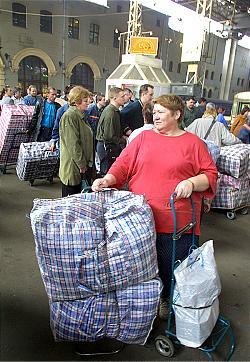
Until now, Narva's economy has largely depended on border trade with Russia. With much lower prices on petrol, alcohol, and tobacco in Russia, shuttle traders cross the border back and forth on a daily basis, bringing merchandise for illegal distribution and sal

e on Estonian and Western markets. There are few figures on the full extent of this trade, but Russian customs' estimates say, that it accounts to some 20-30% of Northwestern Russia's foreign trade. There is no wonder then that transit-trade is Estonia's most profitable business, the proceeds of which have made great fortunes for the people who control it. Today, a majority of Estonia's richest businessmen are ethnic Russians. The paradox is that the population of Narva and Eastern Estonia has had little to gain from the shuttle-trade. Most of the money has ended up in the pockets of a few fellow compatriots that could not care less about the situation of their Russian kin. Therefore, the future of Narva rests on the opportunities to enter other economic areas.
That a rising number of businesses in Estonia are now moving production to Narva is thus very promising. Too long, the level of costs has not been sufficiently geographically diversified to make it profitable moving industry to the East. Now, this has changed, why companies will seek to increase their dividends by lowering costs by relocation. In the meantime, however, a generation of workers has been lost to Eastern Estonia due to unemployment destitution. The old generation may be lost, but the new generation faces a much more promising future, which might allow them to stay on in their hometowns in the East.

 On Monday, Ukrainian Prime Minister Yuri Yekhanurov appealed to the country's business leaders to let employees watch World Cup football matches, Ukrayinska Pravda reports. After two near misses since independence, this is the first time Ukraine's national team has qualified for the World Cup.