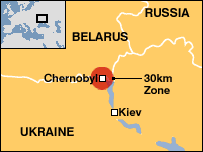
Exactly 20 years ago to the minute, reactor 4 of the Chernobyl nuclear plant 100 kilometres north of Kiev exploded in a nuclear meltdown that ever since has remained a symbol of the dangers of nuclear energy and the hypocrisy of the soviet system. Today, the consequences of Chernobyl stand out as the apocalyptic disaster it was in terms of the thousands of victims that it hit and the grave effects on the environment it had. Morever, it has become a symbol in the hands of different actors, which for various reasons use Chernobyl as a myth in their own interest or for higher purposes.
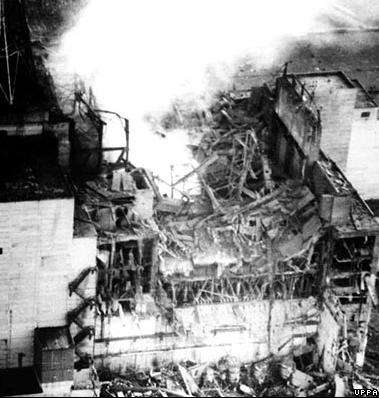
 The factsOn the evening of 25 April 1986, tests on Chernobyl reactor number 4 were initiated. While doing so, numerous safety procedures were disregarded. This eventually created a chain reaction that by 1:23 AM in the morning of 26 April, made the reactor go out of control. This caused an explosion blowing off the heavy steel and concrete lid of the reactor that led to high

radiation levels in the vicinity of Chernobyl. The immediate death toll from the expolosion numbered 30 people. In the days after the nuclear meltdown, evacuation of some 135,000 people in the surrounding 30-kilometre radius were evacutated. During this time, an enormous radioactive cloud spread across Ukraine, Belarus, Russia, and large tracts of Europe. Large quantities of strontium, cesium, and plutionum were spread as radioactive downfall affecting millions of people. The explosion released 30-40 times the radioactivity of the atomic bombs dropped on Hiroshima and Nagasaki. To deal with the accident, thousands of workers and military conscripts were brought or forced to the area around the reactor to cover it with debree, concrete or whatever was at hand, in order to limit further radioactive emission.
In November 1986, an enormous concrete construction was molded - the Sarcophagus - over the wrecked reactor number 4. Some 350,000 tonnes of concrete were used to form a construction intended to last for 30 years. Today, the sarcophagus is gradually falling apart with great cracks in its construction. In December 2000, reactor 3 was definitely closed down, whereas the two other remaining reactors had been put out of use earlier. Some 300,000 people have left the most contaminated areas in Ukraine, Russia, and Belarus. At least 200 villages have been permanently evacuated due to high levels of nuclear radiation. The level of thyroid cancer has increased dramatically among those affected by the accident, among which have been some 2,000 children.
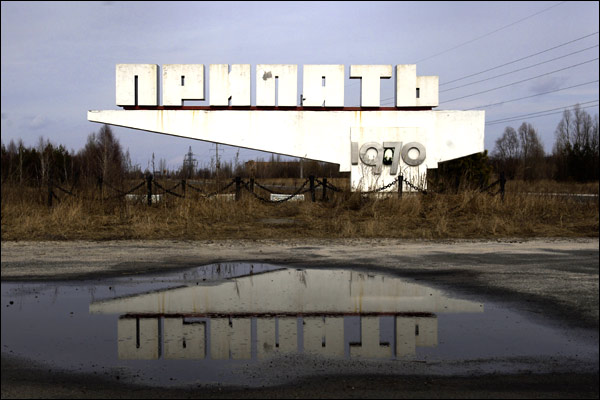
In 1970, the town of Pripyat was founded to house the hordes of specialits and their families coming to work on the reactor from all

over the Soviet Union. With a population of 47,000 with an average age of 26, this was the town most immediately affected by the accident. Today, Pripyat is an abandoned town. This is but a telling example of how entire communities of people - municipal and rural - were disbanded forever to meet with uncertain futures. What today is called "the zone" remains an enormous unpopulated area - with a few exceptions - that for long will remain uninhabited. These are but some simple and concrete facts about the Chernobyl accident and its effects.
The aftermathThe first news of the accident actually reached a western audience. High radioactive levels were registered at Swedish and Finnish nuclear plants already on 28 April. It quickly became apparent that the radioactivity emanated from somewhere within the Soviet Union. Western media immediately picked up the story and in the following days the Soviet government came under great pressure to reveal what had happened.
The first news to a soviet audience came by way of a short TASS-telegramme on 1 May, declaring that there had been an accident with the Chernobyl reactor. One may assume that the date was chosen to drown the message in the 1 May celebrations. It was not until 14 May that Gorbachev informed the public by way of a television statement:
"Good evening, comrades. All of you know that there has been an incredible misfortune --- the accident at the Chernobyl nuclear plant. It has painfully affected the Soviet people, and shocked the international community. For the first time, we confront the real force of nuclear energy, out of control."
The versionsIn a recent report on the Chernobyl consequences,
Greenpeace claims that the death toll due to the accident has been grossly underestimated,
BBC reports. These claims have been forwarded in response to an October 2005 UN report by the World Health Organization (WHO). Whereas the WHO indicates between 4,000 and 9,000 deaths from cancer due to Chernobyl, Greenpeace estimates that the actual number of such deaths will be 93,000. It is obvious that there are different versions. Why?
The myth There are many myths associated with Chernobyl, as seems to be the case with most major events of historical significance. One of the most widespread is, of course, due to a biblical reference, according to which Chernobyl was to herald the second coming or whatever biblical believers may conjure. Chornobyl is, apparently, wormwood in Ukrainian, why one might suppose this should be taken as an omen of the end of the world. Thus the book of revelations 8:10-11 says:
"And there fell a great star from heaven, burning as it were a lamp, and it fell upon the third part of the rivers, and upon the fountains of waters. And the name of the star is called Wormwood: and the third part of the waters became wormwood; and many men died of the waters, because they were made bitter."
This is, of course, the extreme version, but it serves the purpose of pointing out how a tragedy such as Chernobyl is used by various actors. Suffice it to say, this example is perhaps sufficient to point to the plethora of causes for which Chernobyl has been used.
The most recent example is actually Mikhail Gorbachev, who in 1986 had just become the new, young and energetic leader of the Soviet Union. In an
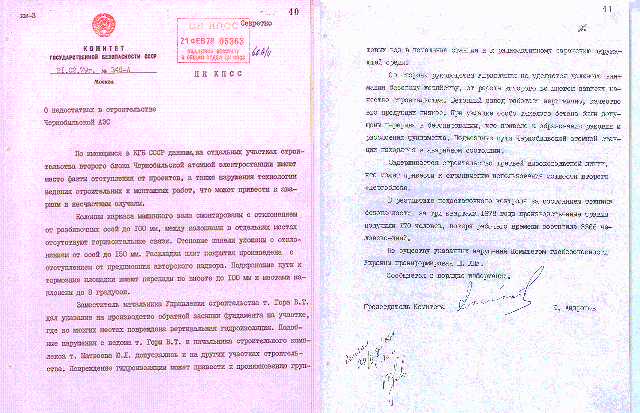
editorial in Daily Star last week, Gorbachev rationalises the demise of the Soviet Union by pointing to the accident: "Chernobyl's meltdown accelerated that of the Soviet Union." Here, one must pause to consider facts and then the causality. Already in 1979,

the Central Committee of the Soviet Communist Party received a report pointing to dangerous deficiencies in the Chernobyl nuclear plant. This might have passed as just another of a flood of reports, were it not for the fact that it was signed by Yuri Andropov, who was to become soviet leader just a few years later. It is a well-known fact that Gorbachev was one of Andropov's protegees. So, people at the very top of soviet leadership were wholly aware of the state of Chernobyl already seven years before the accident. Any argument that soviet leaders did not know, must therefore be discarded. One option might, however, be that Chernobyl was just another of a multitude of such high-level risks that the soviet leaders had to deal with on a daily basis as a fact of political life. This is though not a necessary precondition to deem Chernobyl a major cause of the demise of soviethood. Even former imperial leaders must follow the simple rules of causality: "post hunc, ergo propter hunc."
What Chernobyl became, was the symbol of the state and failure of the soviet system. As such it was an expression that there was something very rotten in the union, and thus served as a contributing factor to soviet demise. The point is, however, that this factor or symbol might have been next to anything properly describing soviet societal crisis. Chernobyl was normality - not anomaly. It was an exponent of the blatant disregard for human life endemic in the soviet system.
What about today then? Is Chernobyl a thing of the past that people simply refer to as an example of recklessness of tantamount proportions? Yes, in some ways it is. Most of the people that use the Chernobyl metaphor probably never have set foot in Eastern Europe, let alone Ukraine or "the zone". Instead, they use it to portray something vaguely ominous to whatever purpose they see fit - for better or for worse. In this way, Chernobyl has become a mighty myth of our age, and who owns a myth may get his message through much more efficiently than millions of dollars. Chernobyl is indeed a mighty metaphor. Reading about Chernobyl one should therefore always ask, who benefits from it: cui bono?
However, this is not the core of the issue. It but serves to illustrate how Chernobyl is used as a utilitarian tool in the hands of whoever may apply it. To the contrary, Chernobyl is intrinsically an ethical and not a utilitarian issue. Why was this allowed to happen? On what values did a society capable of such disregard for human value rest?
Furthermore, Chernobyl is a matter of the value of the individual, in a similar way as the Holocaust. It is not a matter of numbers, even though they have their importance. The heart of the matter is that Chernobyl symbolises the contempt for human dignity and the value of the indvidual that forms the basis of totalitarianism. Therefore, today try to make out a single face among the victims to represent for you this great disaster to mankind. Then, one can start to fathom what Chernobyl really means.

 After a press conference in Minsk this morning, Belarus opposition leader and former presidential candidate Alyaksandr Milinkevich was arrested by Belarus police. The arrest was due to an "illegal" demonstration in Minsk on Wednesday to commemorate the 20th anniversary of the Chernobyl accident.
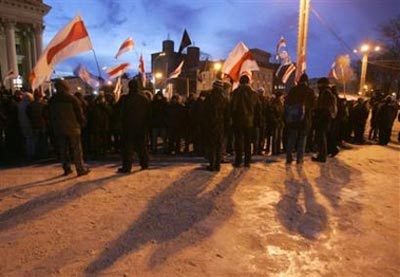 o an opposition rally during recent years, it is remarkable that Belarus authorities chooses this opportunity to clamp down on Milinkevich. Perhaps, it testifies to the desperation of the Lukashenka government, which was gravely shocked by the extent of public protests after massive fraud in the recent presidential elections.