"These are my emotional reactions, jotted down in the margins of life as it is lived in Russia today. --- I live in the present, noting down what I see." This declaration is the outset of Anna Politkovskaya's Putin's Russia (London: Harvill Press, 2004). It is an important and urgent book that Politkovskaya has written, where her unfettered subjectivity is both a strength and a weakness. Thereby, she puts the reader to the test of dealing with his own subjectivity in relation to current Russia. One approach is to read the book as Politkovskaya's Russia rather than as Putin's Russia. Those who want to learn more about Putin are also in for a disappointment.
Politkovskaya is an icon in the international media coverage of Russia. It is hard not to join the ranks of those paying homage to her. In
Putin's Russia the standard of quality has also risen in comparison to her two previous books on the Chechen conflict. The book is fascinating and seducing reading about the cancer that, according to Politkovskaya, is growing in the
corpus of Russian society. Thus, she develops the theme from previous works, though on a wider scale.
How does she describe Putin's Russia? The author, at an early stage, underlines that "This book is not an analysis of Putin's politics." Instead, focus is put on individual fates and processes, claiming to be representative of the state of the nation. Are Politkovskaya's cases representative of current Russia? If so, are they correctly accounted for? These questions are unavoidable, as the cases form into an accusation against Putin, climaxing in a final judgement of this "Akaky Akakievich" of our times. Thus, Politkovskaya cannot avoid scrutiny simply because she "dislikes him." She demands justice and cannot content herself with the president as a symptom of the
malaise sociale of the Russian body proper. Chechnya, Dubrovka, Beslan - that would have been enough. Instead, Putin appears both effect and cause of Russia's moral decline - from excesses and injustices to corruption and bandit capitalism. Putin is guilty, if for no other reason, that he lets it happen. He symbolises the self-continuation of repressive power - the symbiosis of the
nomenklatura and the
noveaux Russes in a hybrid of old and new. Putin represents the continuity of a system that contempts the people, is Politkovskaya's message. At the same time, Putin is absent from Politkovskaya's story. He is a minor character, that still in the end should assume all guilt because "He despises us." These feelings are mutual. Politkovskaya badly covers her despise of Putin, perhaps mostly motivated by that "chance has enabled [him] to clamber to the top of the pile." This sacrilege seems a crime in itself. What about reality - the individual cases that are to prove this guilt?
The desperate struggle against the system of a soldier's mother to reclaim the corpse of her fallen son - Pavel - is contrasted by the same system's struggle to acquit the "war hero" - Budanov - from charges of war crime. While the account of the "Pavel" case is both authentic and characteristic, one might ask whether the "Budanov" case is representative. The use of psychiatry is e.g. put forth as the last straw for the system to rationalise Budanov's crimes. The parallel to the political psychology of the soviet system that Politkovskaya thereby draws, however, poorly corresponds to current realities. Particularities are not equivalent to systematics, no matter how much one might wish so. The state of the army is, contrarily, an area that Politkovskaya masters. She gets her message through with precision: Man is nothing against the dehumanised military system. The loyal and honest are ignored or crushed by the system. "The nail that sticks out shall be hit down."
One is met by the daily struggle of a submarine commander for his own and his family's survival while he still faithfully serves the navy he has dedicated his life to. The old veteran Ivanov is found dead - frozen to the floor of his apartment. The state and the military never cared about them. People are but cogs and wheels of the machinery from cradle to grave. Yeltsin capitulated to the generals and Putin - the officer - has never even tried to reform the army, Politkovskaya claims. She is right about the culture, but as for politics she is naïve. Putin's aim is power and control of the army that he - as an old
chekist - fundamentally distrusts. This is struggle - not capitulation.
By the example of Yekaterinburg, Politkovskaya illustrates how the system unites capitalism and criminality, justice and politics in a system of comprehensive corruption. Yekaterinburg is admittedly infamous, but even when going to extremes, the general theme is familiar. The symbiosis between power and money on local and national levels is nothing that will make the reader raise his eyebrow. This image of Russia is already there. As long as the market does not bother power, it is left in peace.
It is, however, when one enters Russian daily life that Politkovskaya is at her best. One is met by the old neighbour Tanya, who has rid herself of her husband and become a likewise successful as ruthless businesswoman. This mediocrity hardens herself and survives. At the other end of the spectrum, we find the gifted - Misha - who has passed from alocohol to murder, from prison to Orthodoxy, to finally throw himself in front of the metro as a gesture to nobody. In these parts, the inner decline and indifference of man and society are painted in its brightest colours.
That
Putin's Russia is captivating does not mean that one should uncritically embrace the picture Politkovskaya paints. The rage, indignation and temperament is already familiar and here reaches its peak. Politkovskaya is furious with social evils and misuse of power, with the state of man and morale. It is disturbing that she seeks no alternative explanations, no conciliatory traits. The world is divided between rulers and ruled, perpetrator and victim, black and white. Politkovskaya's critical position is clear. There is nothing wrong with that. Her position is, however, not only personal but also journalistic. Therefore, one must ask: Is
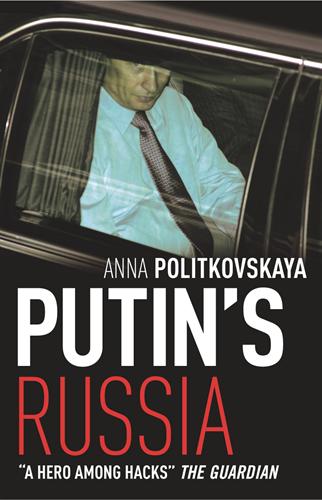
Putin's Russia good journalism? The answer is both in the positive and the negative. The kind of socially and politically engaged journalism that Politkovskaya represents has been lost in the West. Her brutal sincerity can be compared to the coarse realism of the American 1930's and "muckraking". Politkovskaya displays snapshots of reality as she sees it. The book cover sends a clear message: Distanced from realities of the people, Putin is merely seen behind the drapers of power.
Stilistically, the text is screaming of a disharmony that can only be met by the reality that it shows. Regrettably, she describes it - with the zeal of the wronged - in too much detail and at too great length. There is a lack of stringency.
How sources are dealt with is also problematic. What is first-, second- or thirdhand sources? How are they assessed and evaluated? Are they correctly represented and in the right context? Can sources be controlled? The research is enormous and there is nothing wrong with the material. It is all very credible, but at the same time, Politkovskaya's unfettered subjectivity demands a higher standard of veracity. To believe in her is not enough. Would anyone else have been able to write the same and would conclusions be similar?
That Politkovskaya is a child of soviet journalism is also clearly displayed by the fact that she seldom lets the reader draw his own conclusions. One has to tell the people what it should think. Politkovskaya is equally masterful in writing and mastering her readers.
To conclude, to whom does Politkovskaya appeal? She does not reach the Russian public. The book is not published in Russia. A western audience is at the centre, but Politkovskaya is desillutioned with being able to influence western policy towards Russia. Neither does she appeal to power - she depsises it. A higher power that sets all things right is not in her liking. The answer is perhaps as simple as: "listen he, who wants to!" Politkovskaya also deserves listeners.
Putin's Russia is a persuasive and credible account with a pressing message for students and public alike. But "things surely cannot be that bad," one is asked at the outset. Turning the last page, one is left with the feeling that it really is much worse.

 Today, 24 March, is the first anniversary of the tulip revolution in Kyrgyzstan. Whether one may speak of a true revolution is not as clear as in the cases of Georgia's rose revolution or Ukraine's orange revolution.