Friday, March 10, 2006

On a personal note...

This evening, I was elected president of the Swedish Society for the Study of Russia, Central and Eastern Europe and Central Asia. How it all came about, is still somewhat of an enigma to me, but apparently I was regarded a good enough candidate to fill the position, which - I must admit - is both flattering and a great honour. However, it was quite unexpected until only a few days ago.

The Society is an organisation of mainly analysts dedicated to "Eastern Europe". It has some 200-250 members and is the Swedish branch of the International Council for Central and East European Studies (ICCEES). One of the main tasks for the Society over the coming four years will be preparations to host the VIII World Congress of ICCEES, which will take place in Stockholm in July 2010. Thus, great challenges lie ahead but also many interesting encounters and venues. Hopefully, I will learn something from it. If not, I rely on my fellow colleagues to knock me on the head every once in a while to remind me of my faults and shortomings. Either way, I am positive that it will be great fun.

Friday, March 03, 2006

Did the Soviet Union Try to Kill the Pope?

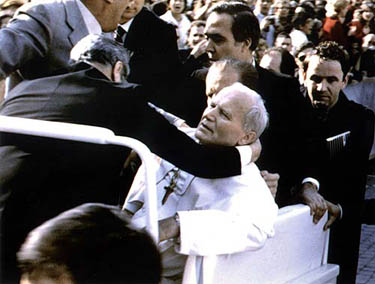
On Thursday, an Italian parliamentary investigation reached the conclusion that the Soviet Union was behind the assassination attempt on pope Paul John II, 13 May 1981, according to RFE/RL Newsline.

The investigation "believes, beyond any reasonable doubt, that the leadership of the Soviet Union took the initiative to eliminate Pope John Paul. They relayed this decision to the military secret services for them to take on all necessary operations to commit a crime of unique gravity, without parallel in modern times."

In a reply to the charges, Boris Labusov, spokesman of the Russian Foreign Intelligence Service (SVR), characterises the Italian allegations as "absurd". The Italian opposition also claims that the investigation forms part of an attempt by Italian Premier Silvio Berlusconi to discredit the leftist parties in the run up to Italian general elections next month. Thus, the investigation report, due to be delivered to parliament only later this month, was leaked in advance to Reuters, the Guardian reports.

Allegations that the Soviet Union was behind the assassination attempt are not new. Already in 1986, Italian prosecutors failed to prove these charges due to lack of evidence. The Italian investigation, however, brings new attention to this line of inquiry, which adds to speculations on how hot the Cold War became in relations between soviet secret services and the Vatican. That soviet leaders saw pope John Paul II as a threat to stability in and soviet reign over Central and Eastern Europe is clear. The question remains if they would have risked even comtemplating a move as reckless and risky as killing the pope. Until proven elsewise, such speculations must therefore be considered a peculiar conspiracy theory.

Earlier this year, the would be assassin, Turkish citizen Mehmet Ali Agca, was temporarily released from jail, having served a 20-year sentence. This provoked widespread international protests, and Agca was again brought into police custody. Agca, a Turkish nationalist, was long considered insane and his attempt on the pope as an act of a madman. In his last book before he passed away last year, pope John Paul II, however, claimed that the attempt on his life was no madman's act and that "someone else masterminded it and someone else commissioned it". It thus looks as if the "pope murder conspiracy" will be a recurrent story also in the future.

Gorbachev Celebrates 75th Birthday by Attack on Yeltsin

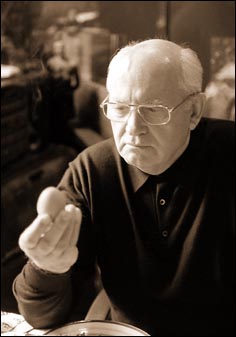
Yesterday, former soviet leader Mikhail Gorbachec celebrated his 75th birthday in a circle of friends that could be described as the "Who’s Who" of Western and Soviet politicians bringing down the Iron Curtain, The Times reports.

In the moderate company of some 200 people, among whom were former German Chancellor Helmut Kohl as well as many old Politburo members, one person was lacking - Gorbachev's successor, Boris Yeltsin. As became painstakingly clear to the many guests, one reason was that Gorbachev used this opportunity for a gruesome attack on Yeltsin, blaming him for the demise of the Soviet Union.

That Yeltsin was not present is perhaps not very strange, as it appears that they have not met each other since they administered the dissolution of the union back in Christmas 1991. “I have never met him [since], and I don’t want to. He feels the same," The Times quotes. Regrettfully, the last remaining witness of these proceeding, Aleksandr Yakovlev, passed away in October (cf. my account of this).

By signing the agreement that dissolved the Soviet Union, Yeltsin "betrayed not only myself, but the nation," Gorbachev said. "It is an unforgivable act of treason."

It is apparent that Gorbachev now deems the moment ripe to rewrite history and his own role in it, by passing the blame on Yeltsin. As history revision has become a popular theme in the Kremlin, Gorbachev's standing in the political élite has improved as of lately - not least in comparison to Yeltsin. Thus, Gorbachev is trying to "set the record straight" e.g. by publishing his new book To Understand Restructuring . . . Why it is Vital Now.

As Gorbachev remains a widely popular figure in the West, his reputation in Russia is, however, tarred. Still, more than half the people blames him for the collapse of the Soviet Union and the subsequent crisis and chaos of the 1990's. His attempts at a return to politics have also ended ingloriously: In the 1996 presidential elections he got a mere 1% of the votes. Changing one's reputation is far from easy - especially if carrying such a heavy burden as Gorbachev is. Eventually, however, history might put him somewhere in between western and Russian perceptions, where he rightfully belongs: A great reformer but also a tremendous failure.

Belarus: Crackdown on Opposition

Two weeks before the 19 March presidential elections in Belarus, the Lukashenko regime is now orchestrating a heavy crackdown on the Belarusian opposition, RFE/RL Newsline reports.

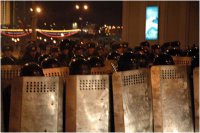
On March 2, police clamped down on the largest opposition rally since 1999, gathering some 3,000 people in central Minsk, in support of united opposition presidential candidate Alyaksandr Milinkevich. In a separate action the same day, police also beat and arrested another of the presidential candidates, Alyaksandr Kazulin.

It now seems that the only candidate that in reality will be allowed to run for the presidency will be the president himself, Alyaksandr Lukashenka. It thus seems correct that "This isn't an election. It's a sham," as BBC quoted Yaroslav Romanchuk of the United Civil Party saying.

At the same time, the regime is orchestrating its soviet-style party congress - the All-Belarusian People's Assembly - confirming a new five year plan for Belarus. Thus, GDP and industrial output are to grow by 50%, and farm production by 40%. Lukashenka, in his three-hour-speech, also took this opportunity to warn for a western conspiracy to bring down his rule. Calling his opponents "bastards", he claimed that the west is spending "hundreds of million" dollars to oust him from power, and that the Belarusian KGB had "busted 72 organizations" that were conspiring to overthrow him. "The opposition is planning a coup", Lukashenka concluded. As opposition candidate Kazulin said, it is becoming increasingly clear that Lukashenka "will do anything, even use force and weapons" to stay in power. In the meantime, a new symbol of opposition is appearing in the streets of Belarusian cities - jeans ribbons clad on lampposts and fences.

Western concern for developments in Belarus is also rising. The EU is following the situation in Belarus with extra attention and worries in Bruxelles are great that things will get out of hand and turn into violent clashes between regime and opposition. Yesterday, a Polish government spokesman also declared that Poland might not recognise Lukashenka as the legitimate ruler of Belarus, according to Polish daily Rzeczpospolita. Worries are also great that a recently adopted law - permitting police to open fire on illegal demonstrators - will be used, and that opposition protests thus will be met by lethal force.

The massive regime crackdown in combination with the fact that the opposition was able to rally that many people for a demonstration might indicate that Lukashenka's grip on power is not so absolute as was expected. Developments in Belarus are becoming very worrisome two weeks before the elections, and who knows to what lengths Lukashenka is willing to go to remain in power. Memories of the orange revolution in Ukraine are still fresh, and the regime seems intent to prevent any similar turn of events in Belarus - come what may. Hopefully, we will not witness blood in the streets of Minsk on March 19, but we cannot eliminate the possibility that this will be the case.

Berezovsky - Coup de Grâce for Coup d'État?

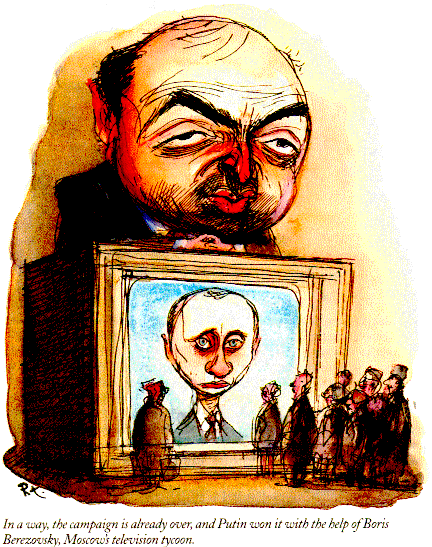
On Thursday, BBC reports that Russian authorities demand the extradition of exiled Russian tycoon Boris Berezovsky on charges of an attempted coup d'état. How Berezovsky would overthrow the Putin regime is still obscure, but the affair adds to the already tense relations between Moscow and London. It may also be a Kremlin attempt to muzzle Berezovsky, who paradoxically has turned into a leading supporter of the Russian oppostition and pro-democracy movement.

Russian allegations might be prompted by an Ekho Moskvy interview with Berezovsky on 25 January. In the interview, the ex-oligarch said that Putin's "regime has lost all legitimacy" and that the president is "leading Russia into the abyss". Putin is "violating the constitution and, today, any forceful actions by the opposition will be justified". "That includes a forceful seizure of power, and that's what I've been working on," Berezovsky reportedly said.

In an attempt to mend UK-Russian relations, British Foreign Secretary Jack Straw declared that Berezovsky could lose his political asylum in Britain. Straw also declared that the government would "take action against those who use the UK as a base from which to foment violent disorder or terrorism in other countries". This adds to Berezovsky's already precarious position in Britain. Only a few years back, Russia demanded his extradiction on fraud charges - a demand not granted by the Britons.

There is little doubt that Berezovsky might orchester the overthrow of Putin, if he had the means and the opportunity to. However, as it is glaringly obvious that he lacks this, Russian allegations seem utterly ridiculous. The image of dark forces abroad has little similarity with reality. Reflecting on Berezovsky as the mastermind to oust Putin and gain power in the Kremlin, one comes to think of Trotsky. Exiled and isolated, Trotsky's mere existence posed a threat to the soviet regime and the - by then - faltered revolution. Is it the same with Berezovsky? Does he know too much about Putin's road to power and eventually must be silenced? It is a well-known fact in Moscow that Berezovsky was one of the people who put Putin in the Kremlin in the first place, which adds a certain flavour to current charges. That he also became one of the first oligarchs that Putin turned on once in power, might have come as a surprise, if not knowing the intricacies of Kremlin palace policies. As an effect, Berezovsky went into self-imposed exile in 2000. A malicious question might well be which coup d'état Berezovsky now is charged for: The successful that brought Putin into power or the current coup-cuckoo?

Finally, has Putin simply invented this attempted coup d'état as a coup de grâce for Berezovsky? Does the Kremlin seriously consider the exiled and immensely impopular Berezovsky a threat to power? Or is it Berezovsky's mere existence that is unbearable for Putin? As for Berezovsky, whose name derives from the Russian national tree - the birch - might only have this left as a symbol of his lost homeland. To most Russians, he instead remains a hated symbol of the 1990's and Berezovsky would perhaps better suit the Kremlin as a "Satan Defiant" than behind bars. The regime's omnipotence must, however, be satisfied and then there is little choice but to cut down any "birches" in the way to resurrected Russia's road to glory.